16 October 2026
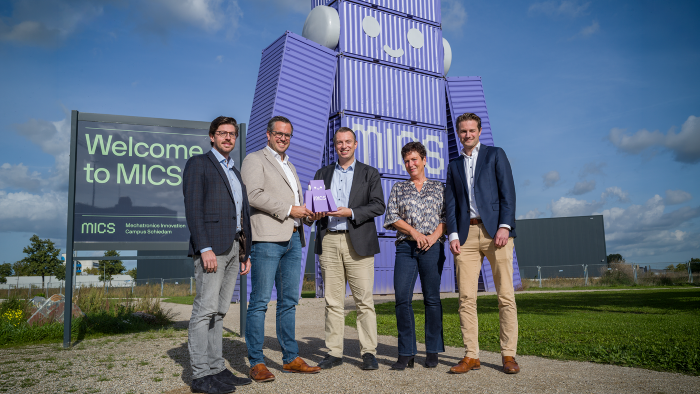
ISISPACE comes to MICS
ISISPACE is coming the Mechatronics Innovation Campus Schiedam (MICS). The company will be based in Atlas, a new building scheduled for completion in early 2028. With the arrival of ISISPACE, international space technology becomes part of the growing high-tech ecosystem at MICS.
Founded in 2006 as a spin-off from Delft University of Technology’s Delfi-C3 nanosatellite project, ISISPACE has grown into an internationally operating space technology company. The company develops and delivers complete satellite solutions, covering the entire lifecycle from design and manufacturing to testing, launch and satellite operations. As such, ISISPACE is the Netherlands’ only satellite developer and manufacturer.
The next step in growth
The move to Atlas marks a new phase in ISISPACE’s development. In recent years, satellite technology has become increasingly accessible and is now widely applied in areas such as, climate monitoring and digital infrastructure. Satellites are used to monitor developments on Earth, gather information and transmit data over large distances. Growing demand for these solutions creates new opportunities for ISISPACE and requires additional room for the organization to develop and expand. The new location at MICS will provide exactly that space.
Jeroen Rotteveel Co-founder and CEO of ISISPACE:
“By establishing ourselves at MICS, we are creating room for the next phase of ISISPACE. We are joining an environment where innovation, talent development and collaboration in the high-tech manufacturing industry come together. This aligns perfectly with our growth ambitions and with the expertise required to develop and deliver the next generation of satellite systems.”
Bringing space technology and mechatronics together
ISISPACE fits naturally within the profile of MICS. The development of satellite systems combines a wide range of engineering disciplines, creating a strong connection with mechatronics. In addition, the campus brings together innovative companies, educational institutions, talent and knowledge within the high-tech manufacturing sector.
Atlas itself will accommodate multiple companies and functions under one roof, while shared facilities are designed to encourage interaction and collaboration.
Niels Langenhuizen, Director of MICS developer SDK Vastgoed:
“With ISISPACE joining MICS, we are welcoming a company that perfectly demonstrates what this campus is designed for. Space technology may appear to be a world of its own, but behind every satellite lies a complex combination of mechatronics, electronics, software, precision engineering and advanced manufacturing. This applies not only to ISISPACE itself, but also to its supply chain partners. It is precisely this type of ecosystem collaboration that we aim to facilitate at MICS. Achieving this requires talent and partnerships across the entire educational spectrum, ranging from academically trained engineers to practically skilled technicians. The arrival of ISISPACE is therefore another important step in the continued development of MICS.”
Connecting regional expertise to international markets
The arrival of ISISPACE also strengthens the connection between regional knowledge institutions and manufacturing industries on the one hand, and international markets on the other. MICS is part of the wider SchieDistrict area development programme and is strategically located on the knowledge corridor connecting Leiden, Delft and Rotterdam. It is also an integral part of the broader knowledge and manufacturing network within the Rotterdam-The Hague Metropolitan Area.
Atlas: Space for manufacturing and collaboration
Construction of Atlas will begin at the end of 2026, with completion planned for early 2028. Located directly alongside the Schie river, the 24,000 m² industrial facility will provide space for production, assembly, research and development, and offices.
The building will also serve as a showcase, making visible from the outside the innovative work taking place within. Shared spaces will encourage interaction and collaboration, while high-bay production areas and logistics facilities will support a wide range of activities within the high-tech manufacturing industry.